Table of Contents
- Your Water Heater's Age and Expected Lifespan
- Rusty, Discolored, or Contaminated Hot Water
- Leaks and Water Pooling Around the Tank
- Inconsistent Temperature and Lukewarm Water
- Unusual Noises: Popping, Rumbling, and Knocking
- Insufficient Hot Water or Frequent Shortages
- Repair or Replace Water Heater: A Clear Decision Framework
- Average Cost to Replace a Water Heater
- Frequently Asked Questions
Last Updated: October 16, 2026
Your Water Heater's Age and Expected Lifespan
Most residential tank water heaters last 8-12 years; tankless units commonly run 15-20 years with annual descaling. Gas and electric tanks fall in roughly the same range, though hard water, high demand, and skipped maintenance push units toward the short end. Past the decade mark, the interior lining has usually begun to corrode, sediment has packed the bottom, and the heating elements or burner work harder to hit the same temperature.
How to Find Your Water Heater's Age
Every unit has a manufacturer's label, usually a sticker or metal plate on the upper portion of the tank, sometimes behind the access panel on electric models. It lists the model and serial numbers, and often the manufacture date. If the date isn't printed, the serial number encodes it, but the format varies by brand:
- First two digits as year: Many brands (including common Rheem and Ruud formats) lead with a two-digit year followed by a two-digit week. "1842..." would mean the 42nd week of 2018.
- Letter-month codes: Some manufacturers use a letter for the month (A = January, B = February, and so on) followed by two digits for the year.
- Date-of-manufacture field: AO Smith and State labels often print the date outright as a separate line, which is the easiest to read.
If the label is faded or missing, check the data plate on the gas valve or upper element cover for a date stamp. When nothing is legible, the installation date on the permit record at your local building department is the next best source.
Check the Warranty Before You Assume Replacement
Tank warranties typically run 6, 9, or 12 years, and the length correlates with tank quality, a 12-year unit has a thicker glass lining and a longer anode rod than a 6-year model.
Most tank warranties cover the tank against leaks but exclude labor, and many prorate coverage after the first few years. A 10-year-old unit still under a 12-year warranty may only yield a partial credit toward a new tank, rarely enough to offset installation. Anode rods and heating elements carry their own shorter warranties (often 1-6 years).
What Shortens or Extends Lifespan
Hard water accelerates sediment buildup and can shave 2-3 years off a tank's life. Annual flushing slows that process but doesn't reverse existing corrosion. Replacing the anode rod every 3-5 years, before it's fully consumed, is the single most effective way to extend tank life, because the rod sacrifices itself so the steel tank doesn't. Once it's gone, rust attacks the tank walls directly.
Rule of thumb: if your unit is over 8 years old and you don't know whether the anode rod has ever been replaced, assume it hasn't, an inspection beats another year of guessing.
Rusty, Discolored, or Contaminated Hot Water
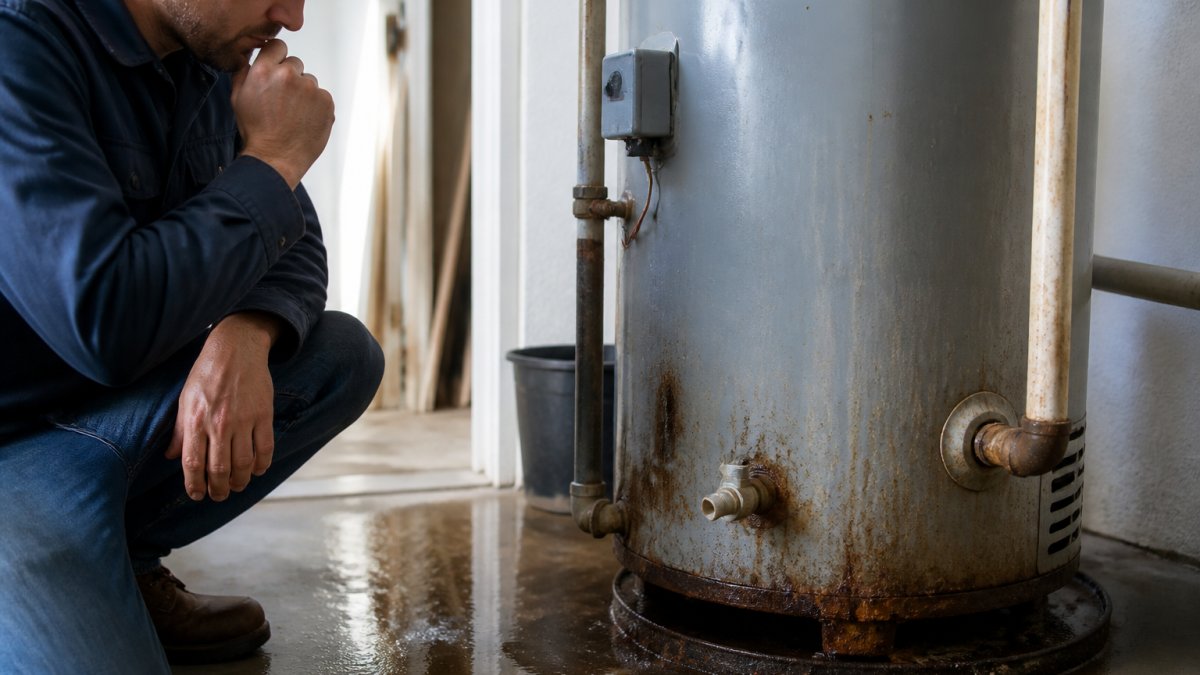
Rust-colored or brown water from the hot tap is a sign your water heater needs replacing. The discoloration indicates internal corrosion of the tank walls or deterioration of the anode rod, a sacrificial component designed to protect the tank from rust.
If only your hot water runs rusty while cold water runs clear, the problem originates inside the tank: the interior lining is breaking down, letting iron particles into your supply.
Sometimes the anode rod, a magnesium or aluminum rod that sacrifices itself to protect the steel tank, has completely corroded away, and rust accelerates rapidly.
Leaks and Water Pooling Around the Tank
Water pooling around the base of your tank is one of the clearest signs your water heater needs replacing, the tank's structural integrity has been compromised.
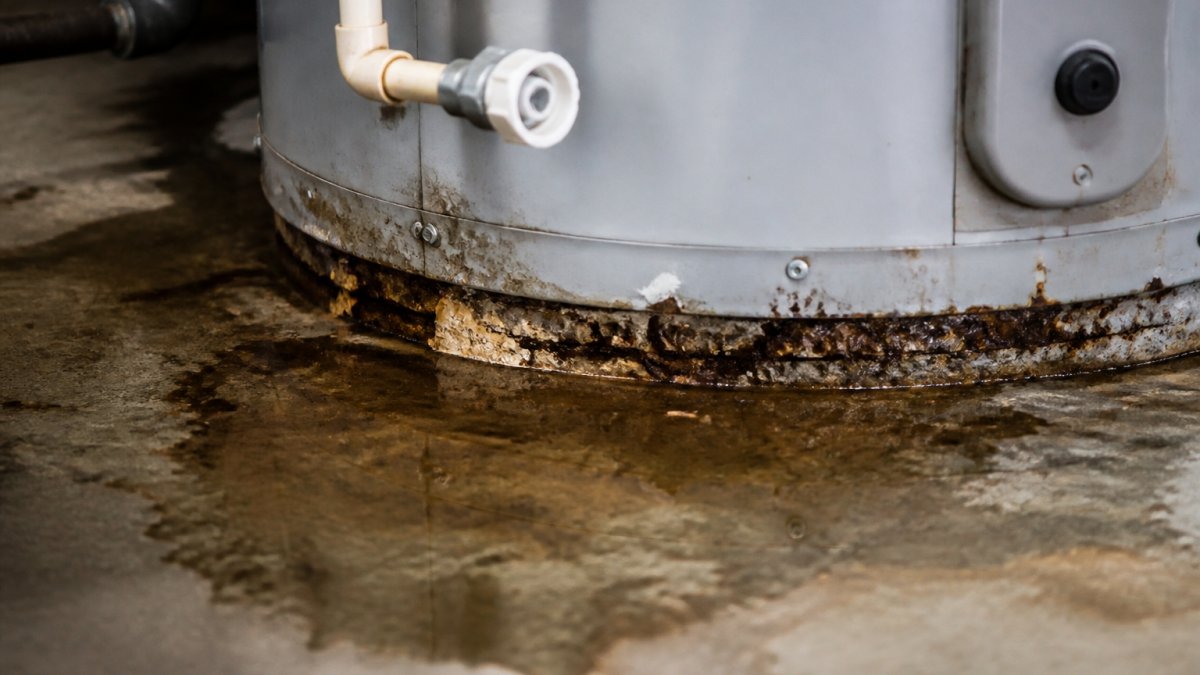
Leaks can originate from the tank seams, the connection fittings at the top, or the drain valve at the bottom. Some are slow and persistent, creating a wet spot or musty smell; others develop suddenly and release significant water volume quickly.
Water Heater Leaking From Bottom: What It Means
A leak from the bottom of the tank is the most serious type: the tank has corroded through at its lowest point, where sediment accumulates and accelerates rust. Once the tank wall has a hole, there's no repair, the unit must be replaced.
Small weeping leaks from the drain valve may be fixable by tightening or replacing the valve. But if water pools around the tank base after you've confirmed the drain valve is tight, the tank has failed, call a professional immediately to prevent water damage to your foundation or surrounding structures.
Inconsistent Temperature and Lukewarm Water
Fluctuating shower temperature, hot one moment, lukewarm the next, signals failing heating elements or a failing thermostat. You may also run out of hot water faster than before, or the water never gets as hot as it once did.
This happens when the thermostat malfunctions or sediment buildup interferes with the heating element. In electric units, a failed element means the tank can't reach or hold temperature; in gas units, the thermostat may not signal the burner correctly.
Temperature swings are also a warning sign: a unit struggling to maintain temperature works harder and consumes more energy. The problem typically worsens, and repairs become increasingly expensive relative to replacement.
Unusual Noises: Popping, Rumbling, and Knocking
Popping, rumbling, or loud knocking from your water heater indicates sediment buildup inside the tank. As water heats, trapped sediment particles move and crack, creating these distinctive noises.
Sediment accumulation is natural, especially with hard water.
A noisy water heater isn't an emergency, but it's a clear indicator your unit is aging and working inefficiently.
Regular flushing reduces sediment buildup, but once the tank is heavily lined with mineral deposits, flushing may do little to restore quiet operation, the noise often means replacement is more cost-effective than continued maintenance.
Insufficient Hot Water or Frequent Shortages
Frequent hot water shortages, running out during showers or lacking enough for back-to-back laundry loads, mean your water heater's capacity is failing.
Either the tank's heating capacity has declined from age and sediment buildup, or the unit genuinely can't meet your household's demand anymore.
Sometimes the culprit is a failed dip tube, the pipe that directs cold water to the bottom of the tank for heating.
A professional inspection can determine whether your water heater needs replacing or a component repair might restore performance.
Repair or Replace Water Heater: A Clear Decision Framework
The repair-or-replace decision depends on three factors: the unit's age, the repair cost, and the remaining useful life.
Age is the primary driver. Under 5 years old with a single component failure, repair makes sense, a failed heating element or thermostat often costs a fraction of replacement.
Compare repair cost to replacement cost. A major repair on an aging unit might cost $300-$500, but if replacement is coming within 2-3 years anyway, you're paying to delay the inevitable.
Consider the failure type. A leaking tank can't be repaired, replacement is mandatory.
Tank water heaters have a finite lifespan; tankless units can last 15-20 years with proper maintenance, though they cost more upfront. Gas units typically outlast electric, but both eventually fail. Knowing your unit's age and condition is the foundation of the right choice.
Average Cost to Replace a Water Heater
Replacement cost depends on unit type, fuel source, tank capacity, and how much existing plumbing, venting, or wiring can be reused. A like-for-like swap in an accessible location is cheapest; switching tank to tankless, or relocating the unit, adds significant labor and materials.
Typical Installed Price Ranges
These are common U.S. installed ranges for a standard replacement, including the unit, labor, and basic hookup:
- Electric tank (40-50 gallon): roughly $900-$1,800 installed
- Gas tank (40-50 gallon): roughly $1,200-$2,500 installed, higher if new venting is required
- Tankless gas: roughly $2,500-$4,500 installed, plus potential upgrades for gas line sizing and venting
- Tankless electric: roughly $1,500-$3,500 installed, often requiring a dedicated 240V circuit
High-cost markets, attic or crawlspace installs, code upgrades (expansion tanks, pan drains, seismic strapping), and permit fees push these numbers to the top of the range or beyond; a straightforward garage or utility closet swap usually lands near the bottom.
What's Actually in the Quote
A transparent replacement quote breaks into four buckets:
- The unit itself, $500-$1,500 for a standard tank, $1,000-$2,500+ for tankless.
- Labor, typically 2-4 hours for a tank swap, 4-8 hours for tankless or a relocation.
- Materials and code items, new flex connectors, a drip pan, an expansion tank where required, T&P valve, and venting components.
- Permit and disposal, many jurisdictions require a permit for water heater replacement, and hauling away the old unit is a line item worth confirming up front.
Ask any contractor to itemize these four categories. A single lump-sum number makes it impossible to compare bids.
Efficiency and Total Cost of Ownership
Purchase price is only part of the picture: water heating is typically the second-largest energy expense in a U.S. home after space heating, so operating cost matters over the unit's life. Higher-efficiency gas tanks (often labeled with a Uniform Energy Factor rating) cost more upfront but cut monthly gas use.
According to the U.S. Department of Energy's guidance on water heater selection, the most cost-effective replacement strategy accounts for both purchase price and operating efficiency over the unit's expected lifespan. A higher-efficiency unit may cost more upfront but deliver lower energy bills and longer service life.
Repair vs. Replace Math
A useful benchmark: if a repair costs more than half the installed price of a new unit and the tank is 8 years or older, replacement usually wins on total cost.
For a quote tailored to your home, contact Rustler Plumbing for an upfront estimate. We provide transparent pricing with no hidden fees and explain exactly what's involved before any work begins. Our licensed plumbers assess your current unit, discuss tank and tankless options, and help you compare total cost of ownership.
Frequently Asked Questions
What is the typical life expectancy of a water heater?
Most tank water heaters last 8-12 years with proper maintenance. Gas models often reach 8-10 years, while electric units may last 10-12 years. Age alone doesn't mean immediate replacement, but a heater past 10 years old warrants close monitoring for signs of failure. Check the manufacturer's sticker on the tank to determine your water heater's exact age.
How do I know if my water heater needs to be replaced or repaired?
Use the repair-or-replace rule: if your water heater is under 7 years old and the repair cost is less than half the price of replacement, repair it. For heaters over 10 years old, replacement is usually more economical than repeated repairs. Multiple simultaneous problems, rust, leaks, and temperature issues, also signal replacement. A licensed plumber can assess whether your specific issue justifies repair.
Can a leaking water heater be repaired?
It depends on where the leak originates. Leaks from inlet or outlet connections, the pressure-relief valve, or the drain valve can sometimes be repaired by tightening or replacing the valve. However, a water heater leaking from the bottom or from the tank body itself indicates corrosion inside the tank and cannot be repaired, replacement is necessary. Have a professional diagnose the leak source before deciding.
What noises indicate a water heater is failing?
Popping, rumbling, and knocking sounds usually mean sediment has accumulated on the tank bottom. As the heating element warms sediment-covered metal, it creates these noises and reduces efficiency. Crackling or hissing may indicate pressure buildup. These sounds don't always mean immediate failure, but they signal that your water heater is working harder and aging faster. Flushing the tank can help, but persistent noises often precede failure.