
Table of Contents
- What Emergency Plumbing Really Costs in 2026
- Emergency Plumber Cost Per Hour: What the Rate Covers
- The Emergency Plumbing Call-Out Fee, Explained
- Emergency vs. Standard Plumbing Repair Cost
- What Drives the Final Bill: Job Type, Access, and Timing
- How to Avoid Hidden Plumbing Fees Before You Approve Work
- Should You Call Now or Wait? A Practical Triage Guide
- Frequently Asked Questions
Last Updated: October 18, 2026
What Emergency Plumbing Really Costs in 2026
The cost of emergency plumbing in 2026 depends on three things: the hourly rate, the call-out fee, and the job itself. There is no single national price. What you pay is built from those parts, and knowing how each one works is the difference between a fair bill and a shock.
At Rustler Plumbing, we quote the job before we start, so the number you hear is the number you pay.
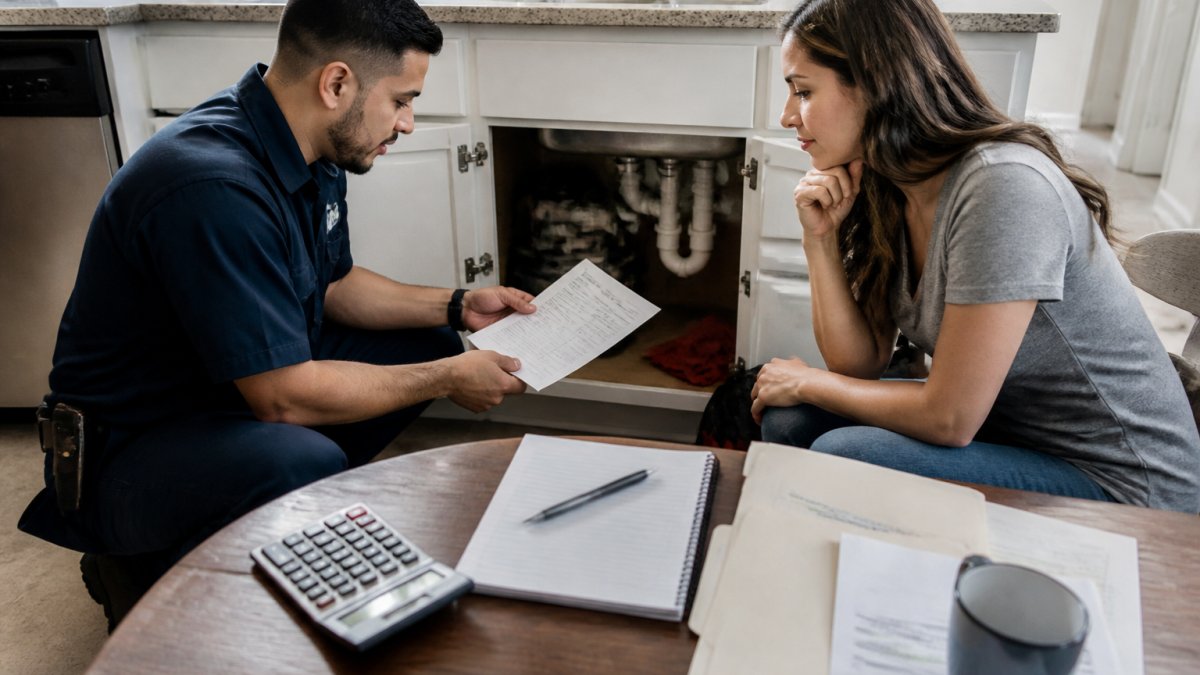
Most homeowners picture one flat price. Reality is closer to a short equation:
- Hourly rate for the time on site
- Call-out or trip fee to get a plumber to your door
- Parts and materials at a marked-up cost
- After-hours premium if it is night, weekend, or holiday
The Consumer Financial Protection Bureau's guidance on home repair contracts is blunt about this: get the scope and price in writing before work begins. That single habit prevents most billing disputes.
Emergency Plumber Cost Per Hour: What the Rate Covers
An emergency plumber's hourly rate covers labor, not the whole bill. The rate pays for the plumber's time on site, their tools, their license, and the truck stocked with parts. It does not usually include the trip fee, parts, or permits.
Rates vary widely by region, by provider, and by time of day. We will not quote a number we cannot stand behind. What we can tell you is what the rate should cover:
- Diagnosis time finding the actual problem, not just the symptom
- Labor for the repair itself
- Basic consumables like tape, sealant, and fittings
A common mistake is comparing hourly rates alone. A low rate with a long diagnosis can cost more than a higher rate that fixes it fast. Ask how the provider bills: by the hour, by the job, or a flat rate. Flat-rate pricing is easier to budget for because the number does not move.
The Emergency Plumbing Call-Out Fee, Explained
An emergency plumbing call-out fee is a flat charge to send a plumber to your property, separate from the labor rate. It covers the trip, the dispatch, and the fact that a truck and licensed plumber are on the way to you specifically.
You will also hear this called a trip fee, service fee, diagnostic fee, or minimum charge. They are not always the same thing, and the difference matters:
| Fee name | What it usually covers | Billed when |
|---|---|---|
| Trip fee | Travel to your address | Every visit |
| Diagnostic fee | Time to find the cause | Often credited toward repair |
| Minimum charge | Floor on any job | Short jobs |
| Service fee | Flat visit charge | Per call-out |
Ask one question: is the diagnostic fee credited toward the repair? Many providers apply it if you approve the work. That turns a separate charge into a deposit. If they do not credit it, you pay twice for the same visit.
Emergency vs. Standard Plumbing Repair Cost
Emergency plumbing costs more than standard plumbing for one reason: timing. A standard appointment is scheduled during business hours and can be batched with other jobs. An emergency pulls a plumber off the schedule and sends them out now.
The gap usually comes from three add-ons:
- After-hours service for nights and early mornings
- Weekend surcharge for Saturday and Sunday
- Holiday surcharge for major holidays
Here is the honest part most guides skip. Emergency work is not always more expensive. If a burst pipe is flooding your floor, waiting until Monday can cost far more in water damage than the premium you pay tonight. The Insurance Information Institute's guidance on water damage claims notes that sudden pipe failures are commonly covered, while long-term leaks often are not. Speed protects your claim as much as your floor.
What Drives the Final Bill: Job Type, Access, and Timing
The final bill is set by the job, not the clock alone. Two repairs that look identical on paper can price very differently once a plumber is on site. Below is how the pieces stack.
Job type is the biggest factor. A simple repair like a fixture swap is quick. A complex repair like a slab leak or a main line replacement is not.
| Job type | Typical labor range | Typical parts range | Typical total range |
|---|---|---|---|
| Faucet or fixture swap | $95-$175 | $40-$150 | $135-$325 |
| Toilet flapper or fill valve | $95-$175 | $15-$40 | $110-$215 |
| Shutoff valve replacement | $125-$250 | $20-$60 | $145-$310 |
| Exposed supply line repair | $125-$275 | $15-$50 | $140-$325 |
| Water heater element | $150-$300 | $30-$90 | $180-$390 |
| Drain cleaning, one fixture | $125-$300 | $0-$25 | $125-$325 |
| Main line drain cleaning | $200-$450 | $0-$50 | $200-$500 |
| Burst pipe inside a wall | $250-$600 | $30-$120 | $280-$720 |
| Slab leak detection and repair | $500-$1,500 | $50-$250 | $550-$1,750 |
| Sewer line repair or replacement | $1,000-$4,000+ | $200-$1,500+ | $1,200-$5,500+ |
| Gas leak repair | $200-$500 | $25-$150 | $225-$650 |
Treat any ranges as a planning tool, not a quote, the only number that matters is the one in writing for your specific job.
Access difficulty adds labor. A pipe behind drywall or under a slab takes longer to reach. That is time, and time is billed. A repair that takes 30 minutes on an exposed line can take two hours once drywall has to come out and go back. Ask the plumber to quote the access work separately so you can see what the wall is costing you.
Parts and materials vary too. Standard fittings are cheap. Specialty valves and tankless water heater components are not. A common pattern is a parts markup over retail, which is normal for the trade because the truck carries the part to you. Ask for the parts line item if the total feels high.
Timing is the last lever. A weekday morning call sits at the base rate. A holiday surcharge sits at the top. The gap between the two can be significant, which is why the same repair can quote very differently depending on when you call.
How to Avoid Hidden Plumbing Fees Before You Approve Work
Hidden fees are rarely hidden. They are disclosed late, after you feel locked in.
Use this before authorizing any emergency plumbing repair:
- Ask for the total repair cost in writing, not a verbal estimate
- Confirm whether the trip or diagnostic fee is credited toward the repair
- Ask if the after-hours premium is a flat fee or a rate multiplier
- Confirm the parts markup or ask for a parts-and-labor breakdown
- Ask what happens if the job uncovers something unexpected
- Get the warranty terms for the repair in writing
- Confirm payment options and whether a card fee applies
- Ask for the license number and proof of insurance before work starts
That last question matters. The Federal Trade Commission's guidance on unfair fees is clear that surprise charges added after the fact can be a problem. A provider who will not put the price in writing before starting is telling you something.
Authorization before extra work. The single most common billing dispute is a job that grows mid-repair. A plumber opens a wall, finds a cracked fitting, and adds the fix to the invoice without a fresh approval.
Minimum charges and diagnostic fees. A minimum charge is a floor on any job, so a 15-minute fix can still bill at the one-hour minimum.
Insurance and home warranty. Sudden, accidental damage, a pipe that bursts, a supply line that fails, is commonly covered by a standard homeowners policy, while long-term leaks and maintenance issues usually are not. The Insurance Information Institute's guidance on water damage claims notes the distinction.
Warranty terms. Ask what the repair warranty covers, how long it runs, and whether it covers labor, parts, or both. A one-year parts-and-labor warranty is a common standard for a repair, but it is not universal.
Payment options. Confirm whether the provider takes cards, checks, or financing, and whether a card fee applies. A card fee is common, and it is worth knowing before the invoice arrives.
Should You Call Now or Wait? A Practical Triage Guide
Call immediately for anything involving gas, sewage, or uncontrolled water. Wait for a scheduled visit only when the issue is contained and not worsening. Most homeowners guess wrong in both directions, calling for a dripping faucet and waiting on a gas smell.
Run this triage:
| Situation | Call now | Can wait |
|---|---|---|
| Smell of gas | Yes | Never |
| Sewage backup into the home | Yes | No |
| Burst pipe, water running | Yes | No |
| No hot water, tank leaking | Yes | No |
| Clogged drain, one fixture | No | Yes |
| Slow leak, bucket catching it | No | Yes, same week |
| Running toilet | No | Yes |
Two rules cover most cases. If water is moving where it should not, or gas is where it should not be, call now. If it is contained and stable, schedule it.
When you do call, know your water shutoff location first. Turning off the supply buys you time and limits water damage before anyone arrives.
A plumbing emergency is stressful enough without wondering whether the bill is fair. The way through is simple: know what drives the price, ask for it in writing, and choose a provider who quotes before they start. Rustler Plumbing has served the area since 2011 with 24/7 emergency service at no extra charge for after-hours calls, upfront pricing with no hidden fees, and licensed plumbers rather than salespeople. We show up when we say we will and fix it right the first time. Book now and get a written quote before any work begins.
Frequently Asked Questions
How much more does an emergency plumber cost than a regular one?
Expect an emergency premium on top of standard service, driven by after-hours scheduling, faster response times, and overtime labor. The exact gap depends on the job type, the time of day, and whether the call falls on a weekend or holiday. Emergency plumbing pricing also often includes a call-out or diagnostic fee that a standard appointment may waive. Ask for the after-hours rate and the standard rate side by side before you approve work, and confirm whether the trip fee is credited toward the repair.
Do emergency plumbers charge a call-out fee?
Many do. An emergency plumbing call-out fee, sometimes called a trip fee or diagnostic fee, covers the visit and initial assessment. Some providers credit it toward the repair if you authorize the work; others do not. Before booking, ask three things: the amount of the fee, what it includes, and whether it is applied to the final bill. Getting those answers in writing prevents the most common billing surprise homeowners report after an emergency call.
Is it cheaper to wait for a regular plumber?
Sometimes, but not always. Waiting avoids after-hours surcharges, yet an active leak, burst pipe, or sewage backup can cause water damage and property damage that costs far more than the emergency premium. Use a simple test: if water is actively escaping, if sewage is backing up, or if you smell gas, call immediately. If a fixture is slow or a drain is partially blocked with no active leak, a scheduled standard service call is usually the lower-cost route.
How can I avoid unexpected emergency plumbing charges?
Ask for a written quote before work begins, confirm whether the call-out fee is credited, and get the after-hours rate in writing. Ask what happens if the plumber finds something unexpected mid-job and whether the price can change. Request a breakdown of labor and parts, and confirm the total repair cost before authorizing anything beyond the diagnosis. A provider that gives upfront pricing and explains the scope in plain language removes most of the room for surprise charges.